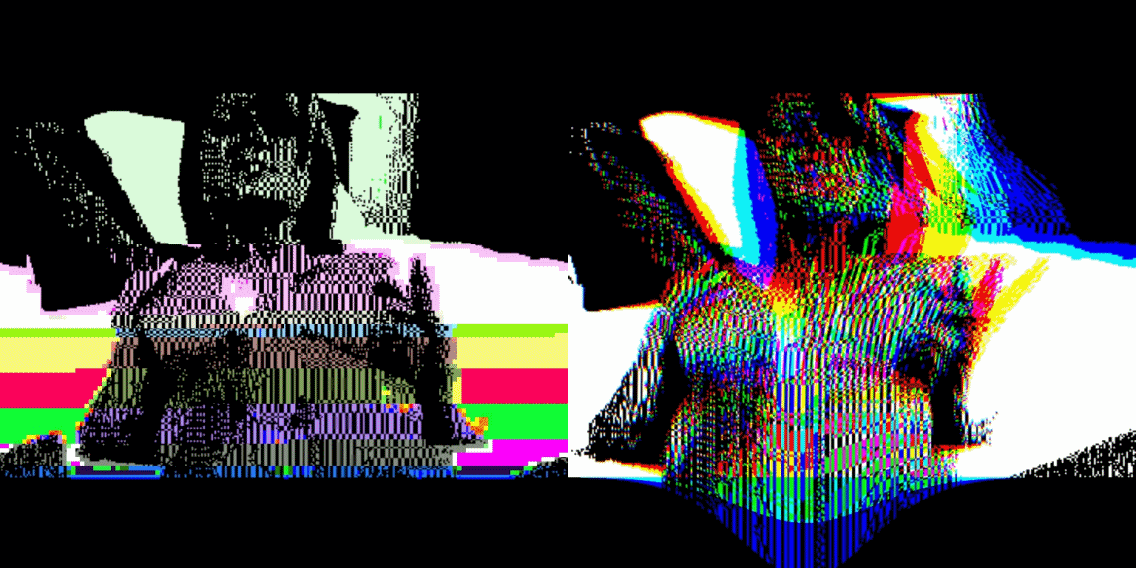
(Oh yea, I'm still here). So A lot of what I do is about finding new ways to break things or discovering exploitable flaws in playback software that create error . Ive also recently got into rebuilding a lot of my old desktop computers so I can research older software and operating systems ( after discovering the flaw in the computer I call the beast). I wanted to recreate the kind of desktop computer I had circa 2005/2006 but in doing so I found something unexpected ( well actually two unexpecteds but I'd like to keep the exact nature of those to myself for now ) . Clues ? Okay well in those days my desktop was an Amd socket A and a nice ATI graphics card ( I've found more error with those than any other brand - failing Nvidia cards just don't count - failure must be continuous and reproducible ) so I rebuilt the old machine with parts I had which were similar to what I had then , loaded up the os I was using then ( any body remember Mandriva ?) and started to play back video , just for nostalgias sake and then this happened !
But Of course I'm more interested in video than stills and I did manage to haphazardly record this, with a web-cam which doesn't do justice to what I'm seeing on the screen. So Ive tried the s-video out on the video card to a seperate computer with capture card but that isn't working max resolution works out at 640x480 and no definition , so back to the web-cam for now - but if I can capture what I'm seeing I will be very very happy .
This is just to show what might be possible .( But for now if you imagine the stills above made into continuous video like below this is what I'm trying to capture).
Sometimes I fall into the horrors, where is the new thing? What shall I make next? What if I can't find anything to make? Why do I keep switching the computer on and off ?
And then I notice something I haven't spotted in ffmpegs list of codecs as I've been experimenting with swapping to Devuan 2 and then from there to Linuxmint19 beta in a desperate attempt to keep my old machines working after the debacle of the meltdown patch stealing my cpu cycles and overheating my processor ( Devuan gives me a decrease of 10% in cpu heat and an increase in compiling speed on my old penryn 2.3ghz dual core) , these are things which make a difference if you're penniless. But back to linuxmint19 beta on the newest Toshiba (c850d-19z) given to me by a friend and since rebuilt, because there are things I need which come with the newer kernel . So where are we going with this ramble - ah yes.
One of the things of being a part of an online community like Glitch artists collective is the sharing of ideas and discoveries, in the pit of despair at ever making anything new again I stumbled across a conversation between a friend Dawnia Darkstone and a few others ( look for Dawnias' work on line - you wont regret it; here https://www.facebook.com/Letsglitchit ) about a codec called zmbv , and lo and behold a way out of my dilemma , not only does it hexedit beautifully it also datamoshs ( more info here https://wiki.multimedia.cx/index.php?title=DosBox_Capture_Codec )
leading to this - my favourite thing so far this year :
There is something very beautiful in the way the pixels slide and break ( the source video is again from the internet archive - an old copy of Pandoras' box starring Louise Brooks - my continuing obsession with old silent films - I like the contradiction of using modern technology with an old tech source plus black and white breaks in a very pure way conjuring colour from other places). The only disadvantage I've found with Zmbv is speed of transcoding - a whole day on my gear to transcode a 45 minute movie, ah well the results are worth it.
And this time I also made stills :
And then of course there is magicyuv , an experimental codec in ffmpeg which is unlike any other I have used so far , all the advantages of raw video but will transcode back to mpeg4 without loss of brokenness . I've yet to try it properly in audacity but I have high hopes for it , and the sound artifacts are an extra bonus
So after all the excitement of the Digital transformations conference , my first time going anywhere on my own for along time I had to get back to making new things .
I've been working for a while on a longer length video based on a copy of Johnny Mnemonic I bought a while back from a charity shop, its Ntsc coded , but as I have a few vhs players stashed for emergencies and nostalgia that play NTSC that wasn't a problem. Why this particular film and why this particular tape ?
Well I saw it when it first came out and later read the William Gibson short story its based on , Johnny Mnemonic fits in with a lot of the Glitch art and Vaporwave work that I follow online, especially the clunky ( though good for its day ) computer graphics and definitely the depiction of virtual reality and all seeing all powerful corporations that have the cures ( and cause) for diseases that they will not release for reasons of profitability. Also the tape was damaged so creating a lot of nice artifacts and noise. Its a nice piece of futurism and early fictional hacker culture , ah the future never seemed so grimy .
So the process goes something like this ; transfer tape to DVD via DVD recorder in real time, play back DVD onto mini TV screen , capture that playback using a circuit bent web cam that I'd recently finished . Edit film , add music . Then came the conference and I'd started to get into rewriting some of the codecs you find in Ffmpeg , so I put it aside until after . When I got back from the conference I'd changed my mind about what I wanted to do with the film , rather than it just being a straight glitching of the whole film I wanted to incorporate more sound and other sources , so I recorded a few more films through the previous method and started to edit at points where the circuit bent copy had dropped out too much to be readable , I want something to be broken , but not so far beyond broken that it becomes unreadable . There was the moment I realised Id have to go back and redo everything because too much light was shining between the screen and the camera , so I had to put a box over the camera and screen otherwise the camera would keep adjusting the white balance - and that black and white worked way better than colour films even though id replaced the infrared adjusted lens with a standard lens, these things matter .
The sound was sourced through the internet archive - old jazz sounds from the twenties slowed down and chopped up in Audacity - I tried LMMS ( Linux multimedia studio) but couldn't get my head round it quickly enough and also 1 other source which was a text file converted to speech using gespeaker , a great text to speech engine , must play around with those more . I wanted to add more sound as I've been told a couple of times that sound would improve the reception of what I'm making .
Anyway In the end the film ended up like this, I quite like the mix of retro hi-tech and old black and white films that I ended up with - all edited on Linuxmint LMDE2 ( due to the debacle of the meltdown and spectre patches messing up render speeds and compiling I had to switch back to pre-patch kernels, huge difference in speed and heat on the cpus under load ) . Clip below is from beginning of the finished film - the full film is here Down and out at the render farm
Glitch art works through the confounding of expectations , we expect to see a face , but then the face disintegrates or turns and leaves a trail of pixeldust , a familiar film disintegrates into chaos , narrative lost as characters melt and blur into one another and suddenly a horse bursts through the centre of a chest , eyes melt , sound squeals and breaks into electronica or voices heard from behind the refrigerator , muffled and high pitched like aliens communicating through a radiator - it relies on a familiarity with what we see on old media and internet memes , images from popular culture , or the screen pixelates into randomness and vhs noise , only to hover back with a half glimpse of an eye , or a horse or a train or an asemic text describing who knows what . If our sources come from the environment in which we move , still life equals the advert I just saw or the half downloaded video from pirate bay or a broken video on youtube. If everything is downloadable everything is usable. For instance Dawnia Darkstones' reworking of the lion King as ' Electronic Divinity' : ( I'm issuing a seizure warning before you watch this as its fairly flashy and flickery )
The material we work with naturally includes that which is copyrighted , we access it either through torrent or screen capture , or ripping , or rarer feedback loops created through arcane systems of mirrors and old crts ( cracked ray tube ) taking this raw material is neutral , using this raw material renders it into something new , a lot of its base material or porn , which asks questions ( what of , exploitation , re-exploitation ) just because of the amount of movement and skin tone possibly , but in the re making it becomes something else - almost un-porn , though erotic glitch is a sub-genre . The internet and other media is all seen as raw material - to make into something new is fine but to take someone else's re- rendered work and call it your own is not okay , as is work which skirts close to being indistinguishable from the raw material .
But then I share a lot of my work under the creative commons license , share and share alike , as long as you grant the next in line who uses it the same rights as you grant originally - a cornerstone of remix culture . and as all source material is available to everyone some things get repeated - see the North Korean parades and the work of Thomas Collet https://vimeo.com/206455322- a natural source we are drawn to like moths to flames - seeking out more obscure sources becomes an obsession in which for me the internet archive holds the key.
The politics of glitch art and open source. ( no mac book required)
Glitch art is a process , that process can be used to describe what is and what isn’t glitch art. To make work in this way it's not enough to have a good brand name expensive computer, often that can be a hindrance leading to a laziness of production, an app can make something which looks like glitch , a glitch alike , but it will have appearance only , the sub culture I find myself in values exploration and discovery , the smooth interface does not lend itself to an inquiry into error , as some of the greatest works of art come out of a restriction of resources so many works of glitch art are made with cheap and broken second hand equipment , it's not the fastest or shiniest device which wins , its novelty , uniqueness, and inquiry , maybe similar to traditional art , what is different though is audience , reception and the gallery of the screen , a painting or sculpture might exist within a gallery as a thing to be seen by a specific audience , they are static , as is film received through cinema or television ,or satellite , what glitch art does that is different is declare here is what we make here are the tools, make something ,it is not received passively it encourages making.
Much of the software and a lot of the methods we use, the simple act of tampering with a codec, or even something as simple as playing a medium such as a dvd with an open source video player including libdvdcss, could in some jurisdictions be considered illegal , in fact much of the content in this presentation has been accessed or referenced in ways which could be considered illegal, ie screen capturing, downloading and reuse of images without consent, in an age when ideas of legality fly in the face of the sheer volume of content and ease of reproduction and manipulation copyright is surely dead . Just like Glitch art itself.
Whilst glitch art does not need galleries or a physical existence , its exhibition space is as wide as the web will stretch it does tend to self organize . Online residencies and exhibition spaces , such as the Wrong http://thewrong.org/
The one thing that the INTERNET is really good at is porn and torrents - ready source material especially the method of the incomplete download - an incomplete file will play and melt in unpredictable and subtle ways , but why use porn as source material at all given its ethical and moral implications? Porn has the movement , texture and color that glitch works well with , and Glitch art reflects the network in which it exists , Facebook groups , server farms , halted downloads , slow speed connections - the anticipation of loading a porn page only for it to halt at the moment of ( climax ) underlines one of the key moments in glitch , the halt state , when what is expected suddenly confounds - the narrative of this becomes the work of artists such as Mathieu St Pierre and his P2p2014 series and his newer clickbait series see more of his work at https://www.mathieustpierre.com/
Mathieu st Pierre - Paxxion 2014
Mathieu st Pierre - click-bait 2016
And the work of Domineco.Dom.Barra aka DMNC_RMX & NITROGLITCHERINA
who puts the dirty into dirty new media , Dom has exhibited widely and worked with Jon Cates of SAIC http://www.saic.edu/profiles/faculty/joncates/ another central figure in Glitch art , and coiner of the phrase ' Dirty new media' which stands in opposition to the clean lines and aesthetically insipid look of commercial digital media and photoshop perfection . Find more of Dom's work here http://homeostasislab.com/Dom-Barra
Manipulating the h261 codec before compiling into ffmpeg
A codec ( short for encode decode ) defines how a moving image , sound or still will be encoded into a data stream or container and can then be read back using the corresponding decoder . We can get between the 2 processes by introducing error at either stage, the nature of that intervention and the codec involved determines the final results , (though often these results need to be captured in playback by using screencapture) depending on variables such as size , format and movement , a video with little movement will not bend that much , a video with lots of movement will change greatly , jpeg is harder to bend than say bmp , raw video reacts to sonification better than H264 . Generally raw file formats are easier to work with than compressed formats , different file viewers will show the same image or video differently , vlc won't play the snow codec , one of the most beautiful codecs to break , but another viewer like mpv will, so hardware and software choices become important , and can change the results of what has been done to a file . In the same way as knowing how to stretch a canvas is important in painting , as is how to mix and thin oil paints or acrylics, Glitch aesthetics are reliant on the building blocks of codecs , or in analog glitch the language of the hardware to which they are tied .
Glitch art is a process , that process can be used to describe what is and what isn’t glitch art - these are some of the processes and programs we use
Mario Pinto Balsameo -2016
Rob Mac - wordpad effect
The wordpad effect - quite simply open a bmp file in wordpad , the standard simple text editor present in windows in windows 95 alter some data , save it as txt , rename it to bmp then open it as an image again , all files are information , they take on their correct form when using the correct program if you use the wrong program they become corrupted - can also be applied to audio and video in most text editors , each giving a different result. Using wordpad also leads into hex editing , the physical manipulation of the hex code that makes up each file in machine readable form.
Sonification - opening an image or video file in an audio editor such as Audacity , applying effects then saving .
Kevin Chambers -divx-aic-dds-audacity
Datamoshing is probably one of the most accessible and widespread forms of glitch art , a way to play with compression artifacts that relies on the structure of video files such as xvid and mp4 which break motion into changing and unchanging , recording only the change between each frame , datamoshing involves either removing the I frames which indicate motion so that images start to blend into each other or interleaving two different videos at points where one breaks through the other pioneered in works such as divxprime a collaboration between Bertrand Planes and Christian Jacquemin in 2006 on a modified divx codec.
Dawnia Darkstone - Cavs Hex-editing and datamosh.
One of the most commonly used tools for this is Avidemux which in older
versions allowed you to load a video file and manually search through a
file removing the i frames then trans-coding the file with the errors
still in place , though primarily a tool that works with h264 in mp4 it
works well with xvid in avi wrapper and strangely webm a newer form of
codec from Google ( otherwise known as vp8/9) which breaks as soon as
you move through it enabling you to live datamosh ( though not on newer
versions ) . There are newer scripts , especially Kasper Ravels' Tomato ( available through git hub) and also the ruby script Aviglitch which automates the tedious task of removing I frames.
Processing is coding for artists , Processing is a bit like a swiss army knife for artists , it covers video , image , sound , interaction in an easily understandable form which is open source and free to use and modify , one of the newer tools we use is made within processing - the glic codec .Which gathers together many of the faults and possibility's inherent within different file formats to enable easier manipulation which can result in images like the next ones:
Daniel Vasconcelas - glic codec in processing.
Mael Lencot - glic and webp
Processing can also be used to create another strand in glitch art , generative art :
Robert Hruska-krotitel-pixelov
Pixel sorting , pixel sorting is probably the most contentious and overused method in glitch art , it basically sorts colour values of pixels by brightness and colour, there are a many tutorials on how to do it , and even photoshop/ae plug-ins you can buy to automate it and make it easy ,( though ease of making implies laziness of thought and the derision of your fellow glitch artists - we prize novelty and a unique approach) original processing scripts were created by Kim Asendorff in 2012 and since then have gone on to delight and ruin many page feeds.
Cliff Potberg - grshit pixelsort-2015
Detterentpoem -pixelsort
Heinz Schielmann-2017
For the truly lazy send a picture to Twitterbot @pixelsorter ( created by Way Spur Chen). Circuit-bending.
My own personal introduction to glitch art was through camera error and finding the work of Philip Stearns and his ‘year of the glitch’ from 2012 find that here https://phillipstearns.wordpress.com/2012/03/12/cameras-of-year-of-the-glitch/ . This is one of the cameras I use in a lot of my own video work stripped down and being worked upon ( here I'm soldering onto the ccd to create shortcircuit points).
There is a whole subculture and companies devoted to rewiring and remaking old video mixers and effects consoles for reuse in video installations , music videos and art , one of the best companies is Tachyons who release well made and desirable video synths .
Tachyons opti-glitch video synth in action.
3d .obj moshing one of the more interesting sub-genres of glitch art involves taking 3d computer models and running htem through the glitch process , best typified by the work of Mark Klink , allied with the possibilities of 3d printing ( and 3d printing error ) this has a real possibility of changing sculptural practice - imagine being able to freely share , download and print and remix, what previously would have been the preserve of the collector, gallery or museum ) find Marks work at http://www.markklinkart.com/gallery/